Using life-sized digital humans, researchers reveal how genital size subtly shapes attraction and rivalry, offering new insight into why human male anatomy is so evolutionarily distinctive.
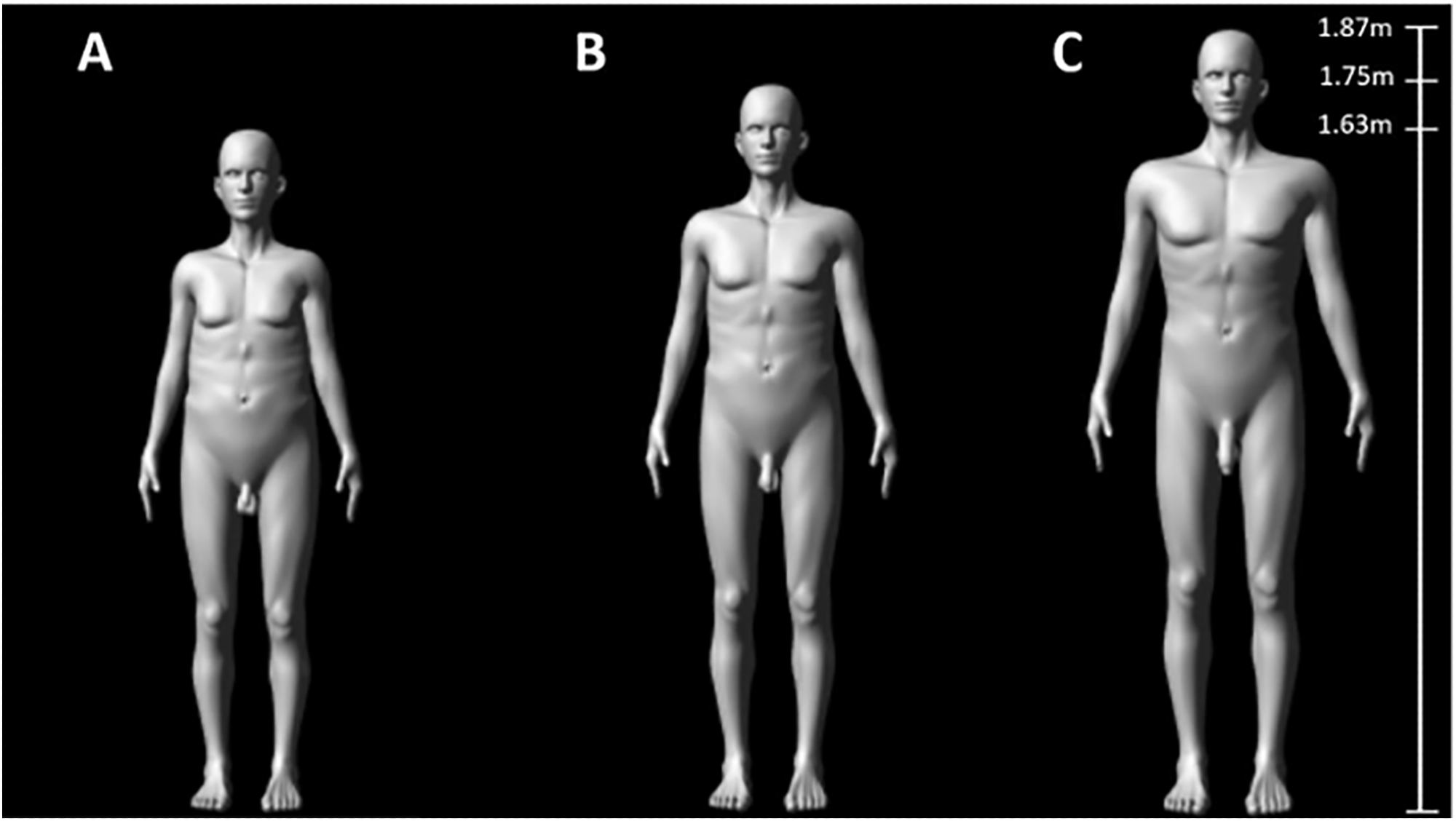
Image Credit: The Authors. Examples of the computer-generated, male figures used in our study. Figure (A) has the smallest values for penis size, height, and body shape (shoulder-to-hip ratio), Figure (B) has average values for each trait, and Figure (C) has the largest values for each trait Study: Experimental evidence that penis size, height, and body shape influence assessment of male sexual attractiveness and fighting ability in humans
In a recent study published in the journal PLOS Biology, researchers utilized 343 computer-generated male figures to investigate the evolutionary role of male penis size in two potential drivers of sexual selection, female mate choice and male-male assessment of perceived fighting ability.
The study found that while women prefer larger genitals up to an optimal range, men view rivals with larger penises as more physically threatening. These findings suggest that human genital size may have been shaped by a dual mechanism, attracting mates and signaling relative formidability to competitors.
Human Male Genitalia as an Evolutionary Puzzle
Compared with other closely related primates, human male genitalia have been described as unusually prominent by scientists. Unlike the great apes, the human penis lacks a baculum, penis bone, and relies entirely on blood flow for rigidity, yet it is generally longer and thicker even when controlling for body size. Evolutionary biologists have consequently long speculated that this exaggerated trait, like a peacock's tail, arose through sexual selection.
Competing Theories, Mate Choice, and Male-Male Competition
Historically, human evolutionary research focused on two main theories. The first is female mate choice, where traits that signal health or genetic quality are preferred. The second is male-male competition, where traits evolve to help males fight or serve as visual signals that influence conflict avoidance.
While studies have confirmed that women generally find larger flaccid penis size more attractive, it was unknown whether genital size acted as a signal of perceived dominance or formidability amongst men. Previous research attempted to explore these associations, but such experiments often relied on line drawings or small images displayed on computer screens, potentially skewing participants' perceptions of physical size.
Experimental Design Using Realistic Male Avatars
The present study aimed to address these knowledge gaps and directly test the fighting ability assessment hypothesis by creating 343 anatomically accurate, computer-generated 3D male figures. These figures varied independently in three specific traits.
- Penis size, ranging from 5 to 13 cm, flaccid.
- Height, ranging from 1.63 to 1.87 meters.
- Body shape, shoulder to hip ratio, ranging from pear-shaped to V-shaped.
Participant Groups and Viewing Conditions
The study cohort comprised over 800 participants, split into male and female groups. To determine whether the viewing medium affected perception, the researchers divided the experiment into two settings. One group was presented with the figures on small screens online, while the other viewed them as life-sized projections on a wall to more closely mimic a real-world encounter.
Measures of Attractiveness and Intrasexual Threat
Female participants were required to rate the computer-generated figures on a scale of sexual attractiveness, with 1 equaling very unattractive and 7 equaling very attractive. Male participants were asked two different questions to assess intrasexual competition.
Attractiveness to females, how jealous would you feel if you saw this man talking to your partner?
Fighting ability, how threatened would you feel if this man wanted to pick a fight with you?
Participant responses were statistically analysed using multivariate selection analyses to calculate selection gradients, thereby estimating the strength and direction of potential evolutionary pressure on each trait, including linear and non-linear effects.
Effects of Penis Size on Attractiveness and Threat Perception
The study provided clear evidence that genital size plays a role in both mating and male-male assessment contexts, although its effects were weaker than those of height and body shape. Across conditions, participants rated taller men with V-shaped torsos and larger penises as more attractive and more physically threatening than their shorter, pear-shaped counterparts.
As expected from previous research, females consistently rated larger penis size as more attractive. However, the data revealed a non-linear trend, known as a quadratic selection gradient (p < 0.001), indicating that while attractiveness increased with size, the benefits plateaued at the upper end of the range, beyond which further increases conferred little or no additional advantage.
Penis Size as a Cue in Male Rival Assessment
Men rated figures with larger penises as significantly more threatening in a potential fight, p < 0.001. Although this effect was modest relative to height and upper-body shape, penis size nevertheless functioned as a statistically significant cue in assessments of fighting ability.
Impact of Viewing Context on Perceived Selection Pressures
Importantly, the study confirmed limitations of previous online-only research. The in-person, life-sized experiments produced substantially stronger selection effects than online surveys. For example, preferences for height were two to three times stronger when participants stood in front of life-sized projections than when viewing figures on small screens.
Response time analyses further showed that both men and women generally took less time to rate figures with smaller penises and shorter stature in several experimental conditions, suggesting that less attractive or less threatening individuals may be cognitively dismissed more rapidly, whereas higher-quality mates or more formidable rivals elicited longer evaluation times, particularly in the life-sized viewing context.
Dual Evolutionary Pressures Shaping Human Genital Size
The present study provides the first robust experimental evidence that men incorporate genital size when assessing a rival’s perceived fighting ability, alongside more influential traits such as height and body shape. The findings are consistent with the hypothesis that the unusually large human penis reflects combined pressures from intersexual selection and intrasexual assessment, rather than serving a single evolutionary function.
While female preference for size may have contributed to the evolution of this trait, the results indicate that penis size may also act as a secondary visual cue among men, potentially facilitating conflict avoidance by influencing perceptions of relative formidability rather than directly determining fighting success.
 Do gut microbes cause autism? New research says diet plays the bigger role